

Has Buc-ee’s Gone Too Far With Its Trademark Enforcement?
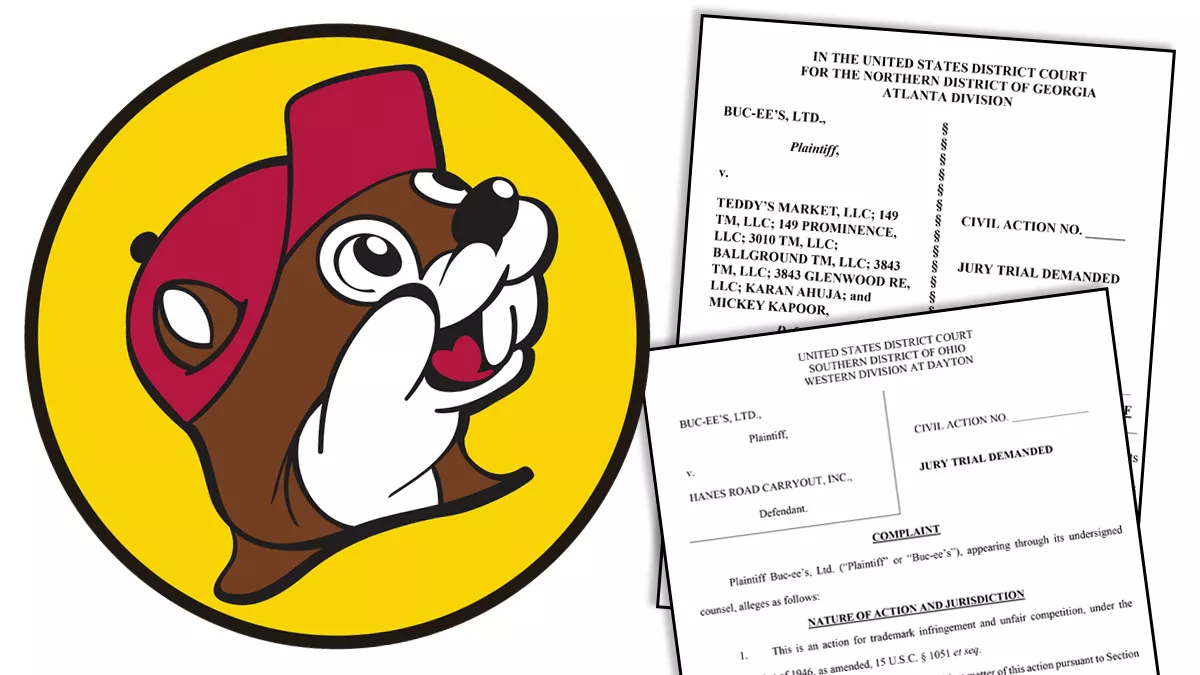
Buc-ee’s has drawn national attention for a series of trademark infringement lawsuits it has brought against small businesses.
The lawsuits have generated many negative headlines and even served as fodder for a segment on Last Week Tonight with John Oliver.
So, is the attention and condemnation deserved?
First, let’s look at the numbers.
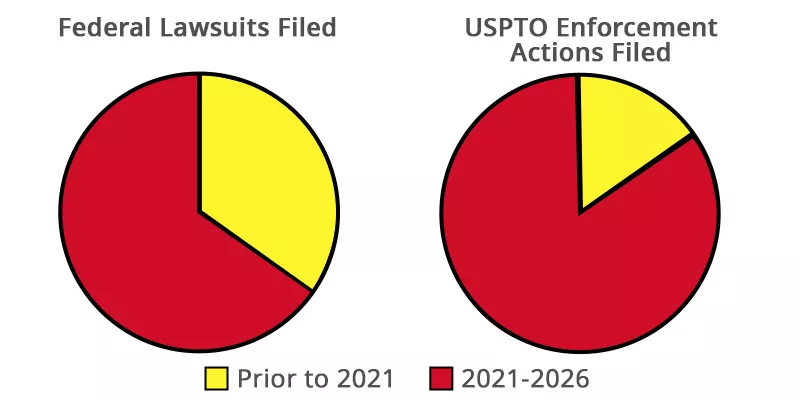
Buc-ee’s has filed a total of 24 federal lawsuits involving its trademarks.
Fifteen of those lawsuits were filed between 2021 and 2026. Four were filed in just the past eight months.
And lawsuits only tell part of the story.
Buc-ee’s has also regularly taken legal action at the U.S. Patent and Trademark Office to block or cancel other companies’ trademark registrations. These cases are known as opposition and cancellation proceedings.
Over the past five years, Buc-ee’s has filed 28 of the 33 opposition/cancellation proceedings it has brought in the company’s entire history. In other words, 85% of the total cases the company has brought with the USPTO have been filed in the past 5 years.
So one thing is clear from the data: Buc-ee’s has become significantly more aggressive about enforcing its trademarks.
Most of that activity has occurred during the past five years, with the pace appearing to accelerate in the past 12-24 months.
Breakdown of Buc-ee’s Trademark Cases
Is Buc-ee’s Just Protecting Its Brand?
Determining whether any particular trademark case is justified is difficult from the outside.
We are not privy to settlement discussions that may have occurred before a lawsuit was filed. We don’t know what demands were made, what compromises were offered, or whether a defendant refused what might have been a reasonable resolution.
That context matters.
But looking objectively at the cases Buc-ee’s has pursued, some certainly appear justified.
Others are head-scratchers.
There is an important point that often gets lost when stories like this go viral: Trademark owners are supposed to police their trademarks.
Under U.S. trademark law, companies cannot simply register trademarks and forget about them. If a trademark owner allows confusingly similar brands to proliferate without taking action, it can weaken its rights and, in extreme circumstances, potentially lose them.
As trademark attorneys, we constantly counsel clients about this legal requirement.
Registering the trademark is only the beginning. You also have to monitor and protect it.
So it is not surprising that a company like Buc-ee’s, which has developed an enormously valuable brand, would aggressively police the marketplace.
The problem is determining where legitimate enforcement ends and bullying begins.
Why Buc-ee’s May Be Getting More Aggressive
There may also be a business explanation for the recent increase in enforcement.
Buc-ee’s is expanding rapidly across the United States
With that expansion likely comes increased internal sensitivity to protecting the brand in markets Buc-ee’s is preparing to enter.
If you are investing significant amounts of money in opening locations in new states, you don’t want other businesses trading on your reputation or creating confusion before you arrive.
That is entirely reasonable.
But aggressive trademark enforcement programs can sometimes get over their skis.
Once a company develops an internal mandate to aggressively protect its brand, the definition of what constitutes a threat can begin to expand.
And that is sometimes how you get trademark enforcement that looks overly aggressive to bystanders.
Buc-ee’s Store Expansion Data
| wdt_ID | wdt_created_by | wdt_created_at | wdt_last_edited_by | wdt_last_edited_at | Opening Date | Location |
|---|---|---|---|---|---|---|
| 1 | 06/22/2026 | Goodyear, Arizona | ||||
| 2 | 8/12/2026 | San Marcos, Texas | ||||
| 3 | 8/17/2026 | Benton, Arkansas | ||||
| 4 | 11/16/2026 | Murfreesboro, Tennessee | ||||
| 5 | 2027 | Ruston, Louisiana | ||||
| 6 | 2027 | Kansas City, Kansas | ||||
| 7 | 2027 | Gallaway, Tennessee | ||||
| 9 | 2027 | Boerne, Texas | ||||
| 10 | 2027 | Monroe County, Georgia | ||||
| 11 | 2027 | Oak Creek, Wisconsin | ||||
| 12 | 2028 | Fort Pierce/St. Lucie, Florida | ||||
| 13 | 2028 | Mebane, North Carolina | ||||
| 14 | 2028 | Lafayette, Louisiana | ||||
| 15 | 2029 | Ocala, Florida | ||||
| 16 | 2029 | West Memphis, Arkansas | ||||
| 17 | 2029 | Oak Grove, Kentucky | ||||
| 18 | 2031 | Hardeeville, South Carolina |
The Real Question Is Consumer Confusion
Trademark law does not give Buc-ee’s ownership over every cartoon animal used by a gas station or convenience store.
That simply isn’t how trademark law works.
To prevail on a trademark infringement claim, Buc-ee’s generally needs to establish that consumers are likely to be confused. This means that an average consumer encountering another company’s name, logo, or branding might mistakenly believe the business is affiliated with, sponsored by, or otherwise connected to Buc-ee’s.
That is ultimately the question at the heart of these cases: Would consumers actually be confused?
Some of Buc-ee’s enforcement actions present compelling arguments that they might.
Others are much harder to understand.
And this is where the imbalance in our legal system becomes important.
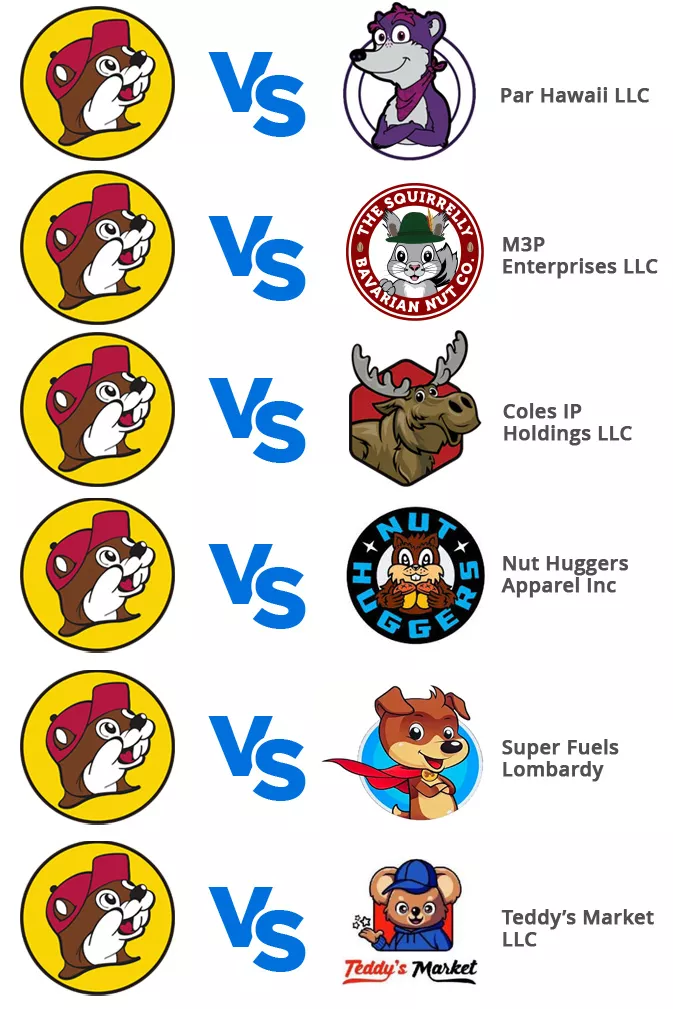
Companies That Buc-ee’s Has Targeted With Trademark Enforcement Action
A Small Business May Never Get the Chance to Prove Buc-ee’s Wrong
Many of the businesses Buc-ee’s has pursued are small businesses.
That matters because even if Buc-ee’s has a weak trademark infringement case, the defendant still has to be able to afford to prove it.
Properly defending a federal trademark lawsuit can be extraordinarily expensive.
Even with a relatively modest litigation budget, taking a trademark case through discovery, depositions, expert reports, motions, and ultimately trial can easily cost hundreds of thousands of dollars. A heavily contested case can reach $500,000 to $1 million (or more) before it even gets to trial.
Now imagine explaining that to the owner of a convenience store with a couple of locations.
That business may not make that much money in a year, let alone have that amount sitting around for legal fees.
So the lawsuit itself becomes leverage.
A large company does not necessarily have to convince a judge or jury that consumers are likely to be confused.
It may simply outspend and overwhelm the small business owner in litigation.
The owner is then left with a litany of bad choices
- Spend an enormous amount of money defending the case.
- Agree to a settlement that may severely restrict the company’s branding.
- Completely rebrand.
This issue is hardly unique to the Buc-ee’s cases
It is one of the fundamental inequities in our legal system.
We have created a system in which gathering the evidence necessary for trial, conducting discovery, retaining experts, and litigating the motions required simply to get your case in front of a judge or jury can require enormous financial resources.
For an individual or small business, keeping up with a company with substantial resources can be nearly impossible.
And until that problem changes, there will always be an opportunity for well-funded companies to use litigation costs as leverage, even in cases where the underlying likelihood of consumer confusion is debatable.
Large Companies Should Be Stewards of Our Legal System
Companies like Buc-ee’s should absolutely protect their intellectual property.
In fact, they need to.
But companies with substantial resources should also recognize the enormous power they wield when they use the federal court system against a much smaller business.
Ultimately, these companies should be stewards of our legal system. Not abusers of it.
That is why John Oliver and others criticizing some of these cases have a legitimate point.
Some of the cases Buc-ee’s has brought appear to be legitimate attempts to protect its brand.
But others look much more like a large corporation exerting its will over a small business.
Buc-ee’s cannot own the concept of animals drawn as caricatures.
It cannot own every animal logo used in connection with a convenience store or gas station.
Trademark law is much more nuanced than that.
Ultimately, you can look at the logos and businesses Buc-ee’s has targeted and decide for yourself whether you believe the legal actions are justified.
But there is one part of this story that shouldn’t be overlooked:
It is very unlikely that the majority of these small business owners targeted by Buc-ee’s will get their fair day in court.
Our legal system is set up in a way that prevents them from getting their case before a judge or jury for a decision.
It is just too expensive.
Read other Gerben IP blogs about Buc-ee’s:

Josh Gerben, Esq.
Josh Gerben, Esq. is a nationally recognized trademark attorney and the founder of Gerben IP. Since launching the firm in 2008, he has overseen the registration of over 10,000 trademarks and handled over 1,500 trademark disputes. Josh's practice focuses on building and defending global trademark portfolios for clients. These clients include entrepreneurs, private equity-backed businesses, athletes, celebrities, and public companies. Frequently quoted by major media outlets like CNBC, CNN, The New York Times, and The Wall Street Journal, Josh is widely regarded as a leading authority in trademark law.
Do you need assistance with a trademark matter?
Contact an Attorney Today