

Jimmy Kimmel Files Trademarks to Protect His Voice and Image from AI
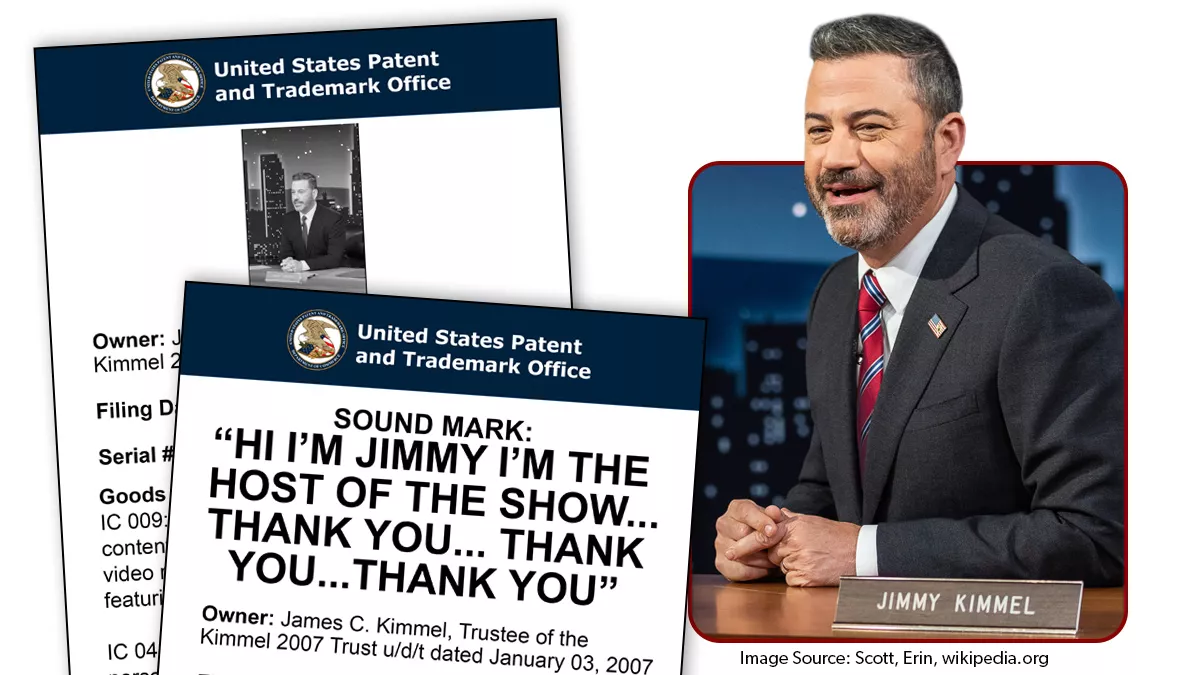
Jimmy Kimmel has filed new trademark applications to protect his voice and image.
The filings, made on April 30, are specifically designed to protect Kimmel from content being created by AI platforms.
The first filing protects a “sound mark,” which is an uncommon type of trademark protection.
Specifically, Kimmel is seeking protection of his voice, saying:
“Hi, I’m Jimmy… I’m the host of the show… thank you, thank you… thanks for coming… thanks for watching at home.”
The other two trademark filings focus on visual images of Kimmel closely associated with his on-air identity. The first depicts Kimmel seated behind a desk with his name displayed on a placard, and another shows him standing on the set of his nightly program.

These trademark filings reflect a new strategy that public figures are using in an attempt to control how their identity is used in an era where AI tools can generate convincing imitations of voices and appearances.
Kimmel isn’t alone. Just last week, Taylor Swift made national headlines by filing similar trademark applications to protect her voice and stage image. And earlier this year, actor Matthew McConaughey also filed trademarks for his likeness and voice.
At the center of these filings is an attempt to use the broad protections that trademarks provide in order to fill a gap in protection.
Typically, copyright law has protected public figures from having people take their images and voices and reproduce them without consent. But copyright law only protects against direct copies.
Trademark law, on the other hand, provides much broader protection.
A trademark is violated if a consumer is confused into thinking the public figure might be associated with the content they are viewing.
Therefore, in theory, these trademark filings would protect Kimmel from any use of his voice or image that a consumer might think is associated with him.
New Trademarks Filed by Jimmy Kimmel on April 30, 2026:
While this sounds logical, it is important to note that this is an emerging legal strategy that has not been tested in court.
No federal court has addressed whether a registered sound mark can effectively block AI-generated imitations of a person’s voice more broadly. The same uncertainty applies to image-based trademarks used to police AI-generated likenesses.
Trademark law in the United States is governed by the Lanham Act, a law that was enacted in 1946, long before computers were commonplace, let alone AI technology.
Now, lawyers are trying to find ways to apply an 80-year-old law to a brand-new technological landscape. This presents a novel challenge for both the lawyers and the courts, who will be involved in these cases.
For now, Kimmel’s filings signal a growing trend: celebrities turning to trademark law to protect themselves from AI.
How will Kimmel enforce his trademarks?
Now that Kimmel has filed the trademark applications, the question is this:
How will these trademark filings be enforced?
First, it is important to note that the USPTO will have to review and approve the trademark applications. This process can take a total of 12-18 months. It is also possible that the USPTO might push back on the applications because they are seeking to protect sounds and images that are not typically protected as trademarks.
That said, after USPTO approval, the first test of Kimmel’s trademark strategy will not be in Federal Court.
It will be a demand letter.
When enforcing trademarks, typically, the first step is to send a demand letter to an infringer.
Therefore, if an AI platform allows a user to recreate Jimmy Kimmel’s voice or image, his legal team can now send a demand letter asserting his trademark rights and requesting the removal of the content.

If the AI platforms respond to the demands by restricting the ability to create content using Kimmel’s voice and images, he wins without ever setting foot in court (and likely so do a lot of other celebrities).
If that happens, the trademark did its job without being tested in court.
That is the practical value of these filings.
However, if the AI platforms push back, especially as more celebrities likely adopt this legal strategy, then the next step is litigation.
At that point, a Federal Court would have to answer the big questions:
Does a trademark registration for a specific voice clip protect against AI-generated imitations of that person’s voice more broadly?
Does a trademark registration for a picture of Jimmy Kimmel behind a desk prevent someone from generating a Kimmel-like late-night host image in a similar setting?
My guess?
I think most judges would be likely to side with the celebrities over the AI.

Josh Gerben, Esq.
Josh Gerben, Esq. is a nationally recognized trademark attorney and the founder of Gerben IP. Since launching the firm in 2008, he has overseen the registration of over 10,000 trademarks and handled over 1,500 trademark disputes. Josh's practice focuses on building and defending global trademark portfolios for clients. These clients include entrepreneurs, private equity-backed businesses, athletes, celebrities, and public companies. Frequently quoted by major media outlets like CNBC, CNN, The New York Times, and The Wall Street Journal, Josh is widely regarded as a leading authority in trademark law.
Do you need assistance with a trademark matter?
Contact an Attorney Today