

Taylor Swift Moves to Trademark Her Voice and Image as AI Threats Grow
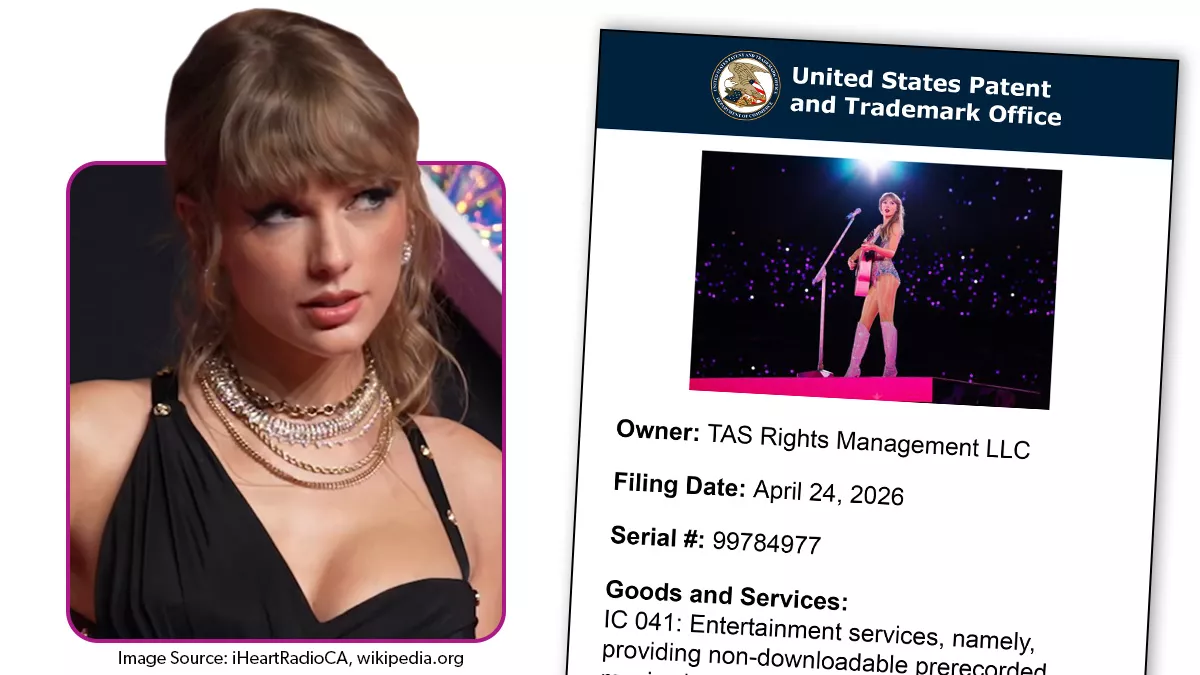
Taylor Swift has filed new trademark applications to protect her voice and image.
The filings, made on April 24, are specifically designed to protect Taylor from threats posed by artificial intelligence.
Two of the filings are “sound marks.” This is a lesser-known category of trademark protection.
Specifically, Swift is seeking protection of her voice, saying:
and
2. “Hey, it’s Taylor.”
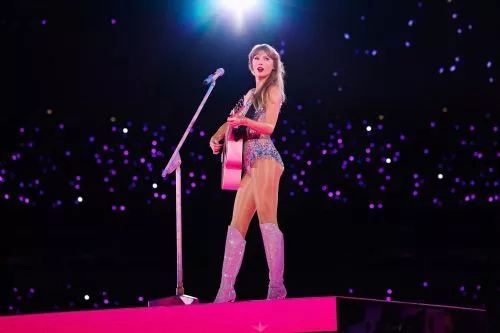
Another one of the filings protects a specific visual image: Swift holding a pink guitar with a black strap, dressed in a multicolored bodysuit with silver accents and boots. The look is closely associated with her recent performances.
The Visual Image Protected by Taylor Swift
The filings arrive as AI-generated content continues to create problems in the entertainment industry. Musicians and actors have increasingly found their voices and images used in unauthorized videos, songs, and digital content that is created by AI and circulated online.
While existing right of “Right of Publicity” laws offer some protection against unauthorized use of a famous individual’s likeness, trademark filings can provide an additional layer of protection.
New Trademarks Filed by Taylor Swift on April 24, 2026:
Swift is not alone in pursuing this strategy. Actor Matthew McConaughey filed similar trademarks in recent months to protect his voice and image. In an interview with The Wall Street Journal, McConaughey said he wanted to ensure that any use of his likeness or voice would require his approval, emphasizing the need for consent and attribution in an AI-driven world.
The concept of protecting sound as a trademark is not new, though it remains relatively rare.
Famous examples of “sound marks” include Netflix’s “tu-dum” and NBC’s “chimes.”
That said, attempting to register a celebrity’s spoken voice is a new use of trademark registration that has not been tested in court before.
Historically, singers relied on copyright law to protect their recorded music. But AI technologies now allow users to generate entirely new content that mimics an artist’s voice without copying an existing recording, creating a gap that trademarks may help fill.
By registering specific phrases tied to her voice, Swift could potentially challenge not only identical reproductions, but also imitations that are “confusingly similar,” a key standard in trademark law.
Theoretically, if a lawsuit were to be filed over an AI using Swift’s voice, she could claim that any use of her voice that sounds like the registered trademark violates her trademark rights.
The image-based filing serves a similar purpose. By protecting a distinctive visual, down to Swift’s commonly worn jumpsuit and pose, Swift’s team may gain additional grounds to pursue claims against manipulated or AI-generated images that evoke her likeness.
A New Trademark Playbook
Swift’s trademark filings suggest a broader shift in how celebrities are applying trademark law to fight back against AI.
Historically, artists haven’t used trademark law this way. Under US law, songs are protected by copyright. And someone’s likeness or image is protected by ‘Right of Publicity’ laws.
But AI has broken that model.
Now, anyone can spin up a version of an artist’s voice, have it say anything, attach it to anything, and distribute it at scale. And the scary part? It doesn’t have to be an exact copy to cause damage.
That’s where trademarks come in.
Trademark law doesn’t just stop identical uses (like copyright law): it stops anything that is confusingly similar to the registered trademark. That’s a much broader right and more powerful tool in an AI world.
So locking up phrases like “Hey, it’s Taylor Swift” and “Hey, it’s Taylor” isn’t just about those phrases. It’s about the voice itself. If anyone creates anything using that voice with AI, Taylor and her legal team could argue it violates her trademark rights.
Same with the image filing. If someone creates an AI-generated version of Taylor in a jumpsuit with a guitar, or something close to it, now Swift has a federal trademark claim.
Trademark claims add a critical element of protection by enhancing the ability to obtain emergency injunctive relief and to recover more damages against the AI platforms themselves.
Ultimately, Taylor Swift and Matthew McConaughey’s recent trademark filings are testing new theories on how trademark law will work in the AI age.
But it remains to be seen if the filings will work as intended. A Federal Court will need a case to stress-test the legal theories behind the filings.
That said, the legal theories behind the filings are strong.
And I look forward to the blockbuster case when Swift sues the AI platforms.

Josh Gerben, Esq.
Josh Gerben, Esq. is a nationally recognized trademark attorney and the founder of Gerben IP. Since launching the firm in 2008, he has overseen the registration of over 10,000 trademarks and handled over 1,500 trademark disputes. Josh's practice focuses on building and defending global trademark portfolios for clients. These clients include entrepreneurs, private equity-backed businesses, athletes, celebrities, and public companies. Frequently quoted by major media outlets like CNBC, CNN, The New York Times, and The Wall Street Journal, Josh is widely regarded as a leading authority in trademark law.
Do you need assistance with a trademark matter?
Contact an Attorney Today