

Supergoop Sues Five Below Over Alleged Knockoff Sunscreen Line

Supergoop, the skincare brand known for its popular sunscreen products, has filed a trademark infringement lawsuit against discount retailer Five Below, accusing the company of selling a copycat sunscreen line designed to mimic Supergoop’s brand.
In a complaint filed this week, Supergoop alleges that Five Below launched a new sunscreen line under the name “Sugargirl” that closely imitates Supergoop’s logo, packaging, and even product names.
Supergoop, founded in 2005, says its brand is widely recognized for its distinctive logo: a handwritten-style script with a large capital “S,” followed by lowercase letters and ending with an exclamation point. This logo appears prominently at the top of every Supergoop product package.
A Comparison of the Product Logos


According to the lawsuit, Five Below began selling the “Sugargirl” line in April 2025. Supergoop claims that the Sugargirl logo is a deliberate imitation—a two-syllable, nine-letter word that also starts with a capital “S”, uses a “G” to star the second syllable, ends with an exclamation point, all rendered in a similarly styled, handwritten script.
The complaint outlines several similarities between the two product lines, including:
- Use of a white tube or bottle with the stylized blue logo at the top
- Product names in all-caps, centered below the logo
- An SPF indicator displayed inside a heart design
- Product descriptors in smaller font below the main name
- Contrasting yellow caps on the packaging
- A shared color scheme of blue, white, and yellow
A Comparison of the Supergoop and Sugargirl Product Packaging


Supergoop also takes issue with Five Below’s use of the name “Glowy Face Screen,” which it says is a direct copy of Supergoop’s well-known “Glowscreen” product.
In the complaint, Supergoop argues that these elements are not coincidental but instead part of a strategy to build a market for Five Below’s products by creating confusion with the Supergoop brand.
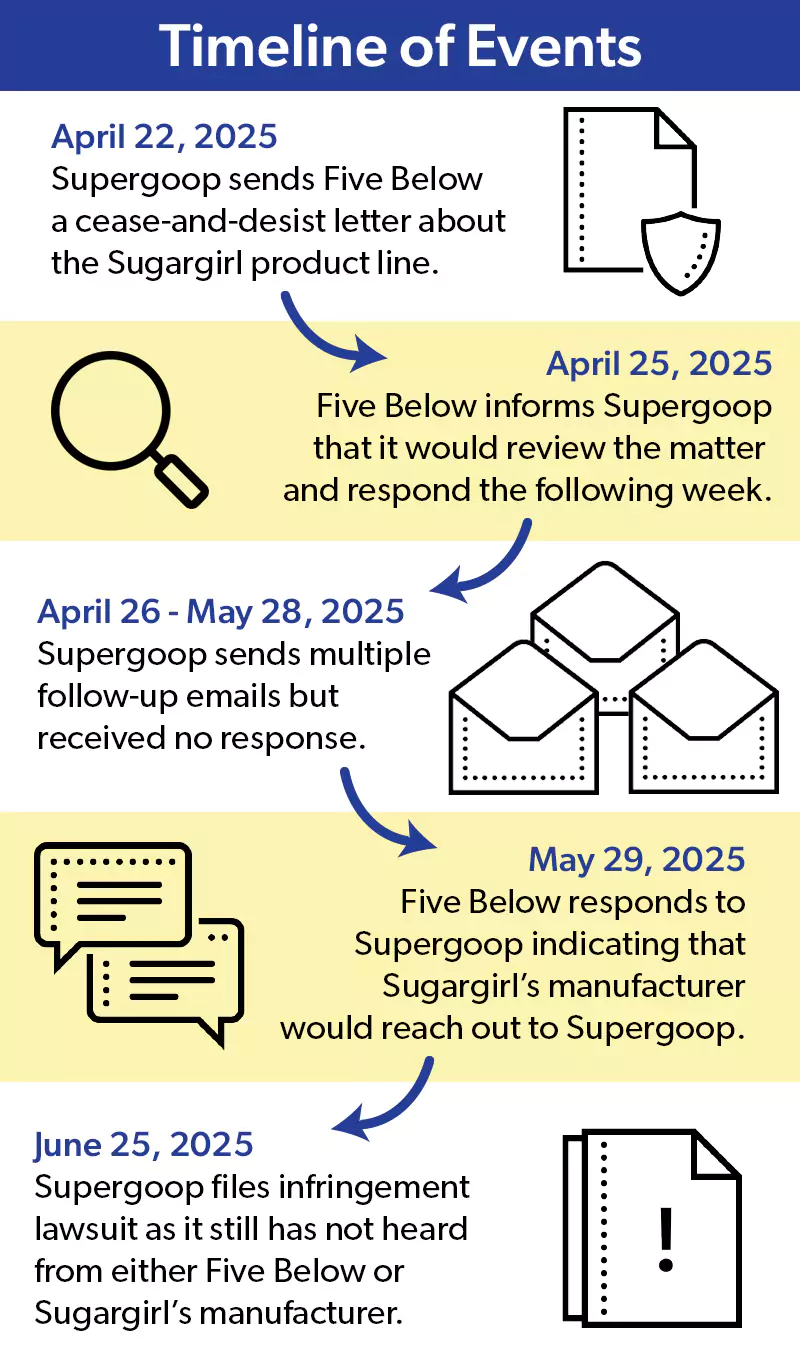
Supergoop’s legal team also detailed a timeline of attempted negotiations leading up to the lawsuit. On April 22, Supergoop sent a letter to Five Below expressing concerns about the Sugargirl line. Three days later, on April 25, Five Below’s in-house counsel responded, saying the company was reviewing the matter and would follow up the next week.
However, despite multiple follow-up emails from Supergoop over the next month, Five Below provided only one brief, non-substantive reply on May 29. In that email, Five Below’s counsel said Supergoop would be contacted directly by iWorld LLC, the manufacturer of the Sugargirl products. As of the lawsuit’s filing, Supergoop says it never received any further response from either Five Below or iWorld.
Supergoop is seeking an injunction to stop the manufacture and sale of the Sugargirl line, along with payment of profits earned from the allegedly infringing products. The company is also asking for attorneys’ fees and litigation costs.
From a legal standpoint, Supergoop’s case appears strong. While the name “Sugargirl” might not raise issues on its own, the combination of the look-alike logo, packaging design, color scheme, and similar product naming could easily create consumer confusion—especially if the products are sold side by side.
Of course, like any trademark case, a fully litigated case always carries uncertainty. Sometimes facts come up that turn a case around in an unexpected way. Therefore, as in most cases, the parties will likely explore settlement options.
This leads to the most surprising element of the case to date: that settlement discussions did not get off to a good start.
In the complaint, Supergoop says it never received any formal response to its demand letter.
Ultimately, this lack of engagement by Five Below may have made this lawsuit all but inevitable.
In trademark disputes, ignoring a demand letter is the fastest way to escalate to litigation. Most brand owners will try to resolve a dispute without going to court. This is because trademark litigation is expensive, and it is challenging to obtain damages at trial. The easiest solution in trademark cases is typically to give an infringer time to sell through inventory and make changes to avoid infringement going forward. But, when a defendant goes silent, filing a lawsuit becomes the only way to get a response.
Supergoop’s outreach followed a common playbook for pre-litigation resolution: sending a detailed letter, following up multiple times, and even tolerating weeks of delay. But with no substantive reply from Five Below, Supergoop appears to have exhausted its options and was left with no option other than to file a lawsuit.
At this point, Five Below will have a few weeks to file its Answer. If settlement discussions do not pick up in earnest, the case would then head to the discovery period and ultimately a trial.

Josh Gerben, Esq.
Josh Gerben, Esq. is a nationally recognized trademark attorney and the founder of Gerben IP. Since launching the firm in 2008, he has overseen the registration of over 10,000 trademarks and handled over 1,500 trademark disputes. Josh's practice focuses on building and defending global trademark portfolios for clients. These clients include entrepreneurs, private equity-backed businesses, athletes, celebrities, and public companies. Frequently quoted by major media outlets like CNBC, CNN, The New York Times, and The Wall Street Journal, Josh is widely regarded as a leading authority in trademark law.
Do you need assistance with a trademark matter?
Contact an Attorney Today