

Sara Blakely’s ‘SNEEX’ Trademark Faces USPTO Refusal—Can She Overcome It?
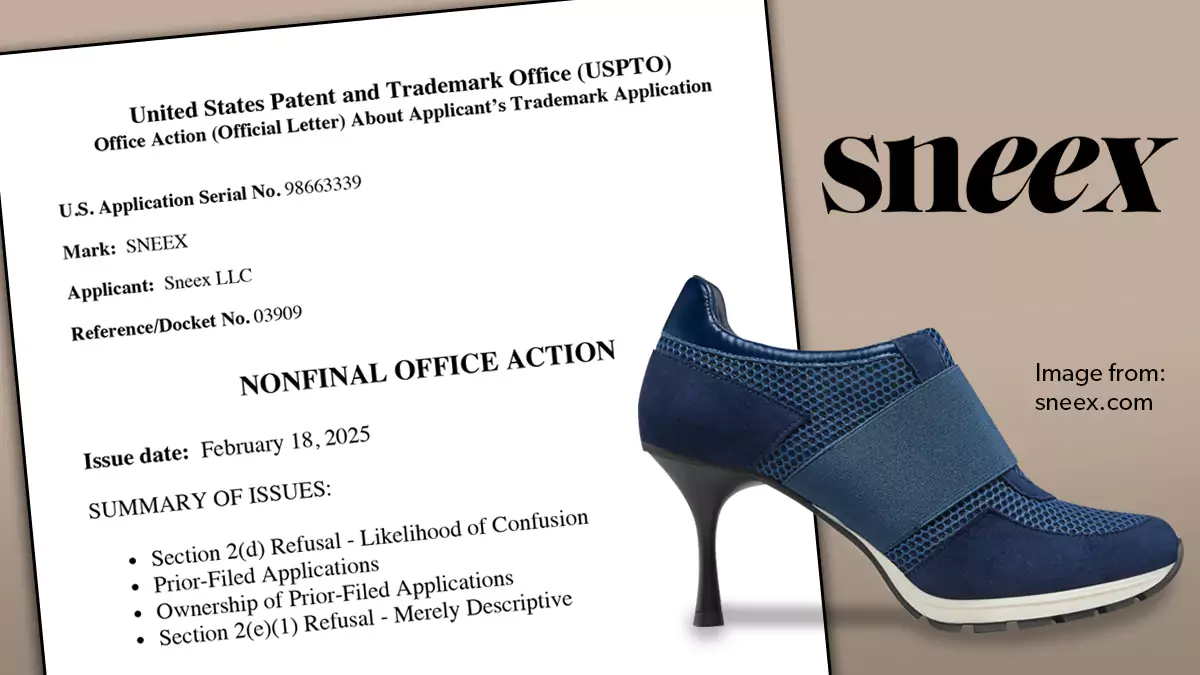
Sara Blakely, the visionary entrepreneur behind Spanx, has recently launched a new brand of high heels called ‘SNEEX.’
The heels are designed to be as comfortable as sneakers.
However, there is one problem. The United States Patent and Trademark Office (the “USPTO”) has denied Sara’s trademark application for ‘SNEEX.’
The refusal is based on two grounds:
- That ‘SNEEX’ is too similar to an existing registration for ‘SNEAK’ (which is also registered for footwear); and
- That ‘SNEEX’ is “merely descriptive” of the goods.
While these refusals present challenges, they are not insurmountable. In fact, many companies that file trademark applications receive similar refusals.
Here’s how Blakely and her legal team could overcome these obstacles.
1. Overcoming the refusal due to the similar ‘SNEAK ‘ trademark.
One of the key issues in this case is the prior registration of ‘SNEAK,’ which is owned by a UK-based company, Sneak Energy. This company primarily sells nutritional supplements but has also claimed that it sells clothing (including footwear) in its US trademark registration.
A strategic first step in overcoming this refusal would be to determine whether this ‘SNEAK’ trademark registration is actually valid in the US. Since the registration is owned by a foreign company, several weaknesses in the registration could potentially be exploited.
First, I would look at how Sneak Energy actually uses the ‘SNEAK’ trademark on clothing. For example, if the company’s clothing items simply feature the brand name in large print on the front of shirts and hoodies (and the trademark does not appear on labeling, tagging, or packaging), this would be considered only an “ornamental use.” Under U.S. trademark law, this type of “ornamental use” would not establish valid trademark rights for clothing.
To assess how Sneak Energy is using the trademark on clothing, an investigator could conduct a “test purchase” to determine if the mark is being properly used in commerce. Furthermore, I would have the investigator determine if ‘SNEAK’ was actually selling footwear in the US (as claimed in its registration).
If the test purchase and further investigation reveal weaknesses in Sneak Energy’s claim over clothing and footwear, a partial “Petition to Cancel” its US registration could be filed. This would seek to remove or limit the scope of Sneak Energy’s registration, particularly in relation to apparel and footwear. If successful, this would easily clear the way for ‘SNEEX’ to be approved.
Finally, I should note that canceling the ‘SNEAK’ registration for clothing or footwear would not be a prerequisite to getting ‘SNEEX’ registered. The owners of the ‘SNEAK’ mark could also simply tell the USPTO they are OK with the ‘SNEEX’ trademark being registered.
This would be done via something called a “Consent Agreement.” For example, if SNEEX files a ‘Petition to Cancel’ the SNEAK trademark (or threatens to do so via a demand letter), the parties could decide to try to negotiate a resolution (rather than litigate). One possible negotiated solution is that ‘SNEEX’ lets ‘SNEAK’ keep its registration in exchange for ‘SNEAK’ providing written consent to the USPTO indicating that it is OK to register the SNEEX trademark.
2. Overcoming the descriptiveness refusal
The USPTO has also refused registration to ‘SNEEX’ on grounds that the trademark is descriptive of footwear. The USPTO’s examining attorney has argued that ‘SNEEX’ is phonetically equivalent to “sneaks,” a common shorthand for sneakers.
Under trademark law, descriptive marks are not capable of registration because they merely describe a product’s features rather than functioning as a unique brand identifier. The general policy is that if descriptive marks could be registered, then others in the industry might be prevented from using the phrase that is needed to describe their own products.
To counter this, Blakely’s legal team could argue that ‘SNEEX’ is not purely descriptive but rather suggestive. A suggestive mark “suggests” what a product is, as opposed to describing it.
Typically, a suggestive mark requires consumers to make a mental leap to understand the connection between the name and the product. There are several points to support this argument for ‘SNEEX.’
a) Multiple meanings of “sneak”
The term “sneak” has various meanings beyond footwear. It can refer to being covert or stealthy, or even the act of stealing. Because of these multiple definitions, consumers would not immediately associate ‘SNEEX’ with sneakers, creating the necessary level of ambiguity for suggestive status.
b) Unique spelling of ‘SNEEX’
While ‘SNEEX’ is phonetically equivalent to ‘SNEAKS,’ the spelling ‘SNEEX’ is distinctive and does not directly correspond to any common English word. The USPTO often considers creative spellings as a factor in determining whether a mark is suggestive rather than descriptive.
c) The products are not actually sneakers
While sneakers are traditionally associated with comfort, Blakely’s ‘SNEEX’ line is focused on high heels that feel as comfortable as sneakers. This introduces an element of incongruity that reinforces the suggestive nature of the mark. Ultimately, the products are not sneakers but heels. Consumers must make an additional cognitive leap to connect the name to the actual product, supporting the argument that ‘SNEEX’ is not merely descriptive.
Finally, in addition to making these arguments, Sara could amend her trademark application to change the claim from “shoes” and “footwear” to something more specific—such as “heels.” This could help the USPTO examining attorney approve the application since ‘SNEEX’ is arguably not descriptive of “heels” (but might be of shoes).
Final thoughts
Despite the USPTO’s initial refusal, I believe Blakely’s legal team could use the foregoing techniques (and others) to successfully obtain a registration on ‘SNEEX.’
Ultimately, this is a great brand name.
It brings to mind an element of comfort to the consumer in a type of footwear that is notoriously uncomfortable. The name is playful and also a nod to SPANX (starting and ending with the same letters).
I wish Sara and her team the best of luck with SNEEX. Even though I am not the target demographic for the product, I do plan to buy a pair for my wife.
And, yes, she will have to hear all about my analysis of the trademark.

Josh Gerben, Esq.
Josh Gerben, Esq. is a nationally recognized trademark attorney and the founder of Gerben IP. Since launching the firm in 2008, he has overseen the registration of over 10,000 trademarks and handled over 1,500 trademark disputes. Josh's practice focuses on building and defending global trademark portfolios for clients. These clients include entrepreneurs, private equity-backed businesses, athletes, celebrities, and public companies. Frequently quoted by major media outlets like CNBC, CNN, The New York Times, and The Wall Street Journal, Josh is widely regarded as a leading authority in trademark law.
Do you need assistance with a trademark matter?
Contact an Attorney Today