

USPTO Fee Changes in 2025: What Foreign Companies Need to Know
The United States Patent and Trademark Office (USPTO) has introduced a new fee structure for trademark applications and related filings, effective January 18, 2025. These changes aim to incentivize the use of the ‘pre-approved’ USPTO identification of goods and services and speed up the examination process.
The most significant update is a shift to a single base application fee for applications under Sections 1 and 44 of the Trademark Act, which make up the majority of trademark filings in the United States. Additional fees may also be applied based on the complexity and completeness of the application.
These changes will impact the common “laundry list” filing strategy often used by foreign trademark applicants. Overseas companies and their attorneys must adapt their approach to U.S. filings or risk incurring significant increases in government and legal fees.
1. Fee changes will make overly broad trademark applications more expensive
Foreign companies frequently file trademark applications in their home countries, secure registrations, and later use those registrations as the basis for filing in the United States.
Unlike the U.S., many foreign trademark offices allow broad identifications of goods and services without requiring proof of use. As a result, some foreign companies include extensive lists of goods and services (sometimes hundreds of items) in their trademark applications.
Subsequently, foreign counsel often instructs U.S. counsel to replicate the same broad filings in the United States. This strategy has long been inefficient and burdensome for USPTO examining attorneys, who expend considerable resources reviewing overly broad applications.
Under the new fee structure, this approach will become financially unsustainable.
Key USPTO fee changes for foreign companies and their attorneys:
- $200 fee/class to use a free-form text box for goods/services (up to 1,000 characters)
- $200 fee for each additional block of 1,000 characters used in the free-form text box
For trademark applications with expansive lists of goods and services, these additional fees could quickly grow.
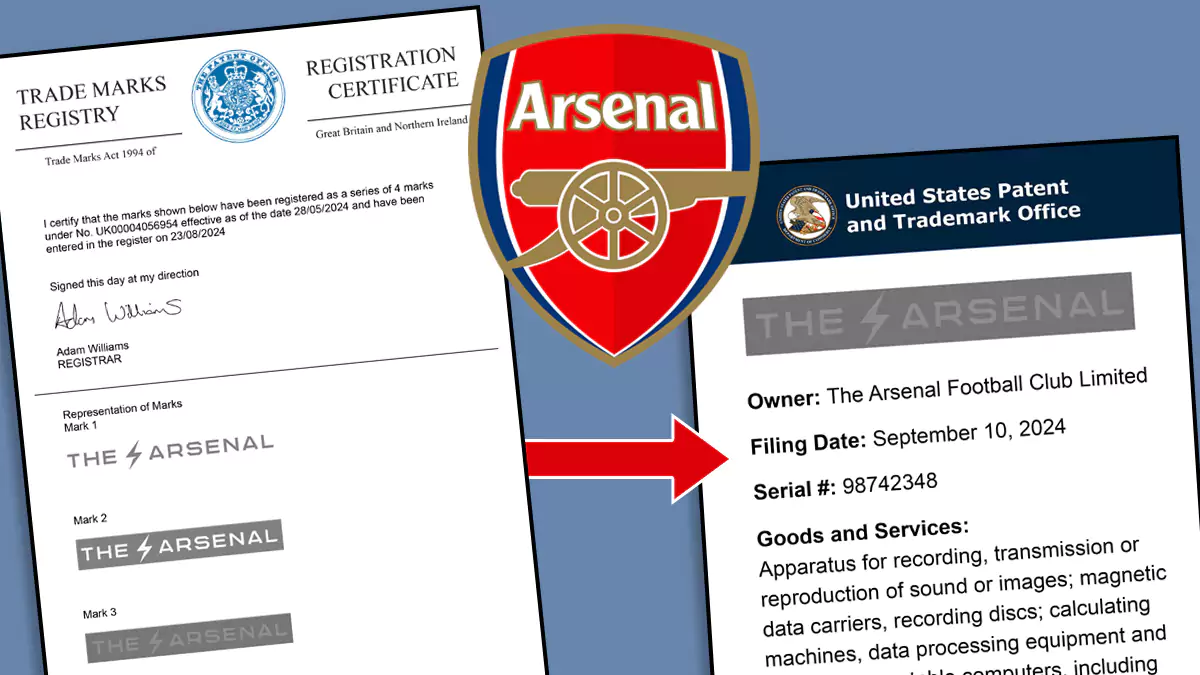
As an example, let us examine the trademark application filed by The Arsenal, an English football club, to protect a logo for “THE ARSENAL.” This application includes an extensive list of goods and services across multiple classes.

Remember, under the new fee structure, the USPTO will charge a $200 fee for use of the free-form text block (up to 1,000 characters), as well as an additional $200 fee for each subsequent blocks of 1,000 characters. These additional charges are calculated for every class included in the application.
The table below shows:
- each class in the application
- the number of characters in each class
- the number of boxes under the new rules (characters/1,000)
- the 2025 USPTO fees for each class (blocks x $200)
| Class | # of Characters | # of Blocks | 2025 USPTO Fee |
|---|---|---|---|
| 009 | 3,882 | 4 | $800 |
| 018 | 1,139 | 2 | $400 |
| 025 | 1,429 | 2 | $400 |
| 028 | 2,339 | 3 | $600 |
| 035 | 10,764 | 11 | $2,200 |
| 038 | 1,338 | 2 | $400 |
| 041 | 5,545 | 6 | $1,200 |
| 042 | 4,100 | 5 | $1,000 |
| $7,000 (total) |
Under the new fee structure, the total additional charges for this application would be significant.
Here’s a cost comparison:
| Description | Current Fees | New Fees (2025) |
|---|---|---|
| Base Fee ($350/class x 8 classes) | $2,800 | $2,800 |
| Additional Charges | $0 | $7,000 |
| Total | $2,800 | $9,800 |
It is important to note that the numbers above are only indicative of the government filing fees and do not include any attorney fees.
2. Strategies to minimize expenses under the new USPTO fee structure
To avoid excessive costs, foreign counsel should revise their approach to trademark filings in the U.S. Here are some practical steps:
- Limit the scope of goods and services.
Focus on specific goods and services that are relevant to the client’s actual or intended use in the U.S. - Provide concise instructions.
Collaborate closely with U.S. counsel to ensure applications are clear and precise. Avoid including unnecessary items in the descriptions. - Verify bona fide intent.
Ensure that all listed goods and services are supported by the client’s bona fide intent to use them in U.S. commerce.
By adopting a more focused approach, applicants can avoid additional fee blocks and improve the overall strength of their applications.
Final thoughts
The 2025 USPTO fee changes present a significant shift for foreign trademark applicants and their attorneys. To navigate these changes successfully, it’s essential to prioritize clarity, precision, and strategic planning when filing in the United States.
At Gerben IP, we have always prioritized crafting tailored applications that align with our clients’ actual business needs. Our approach ensures predictable costs and minimizes the risk of application rejections or cancellations.
If you have questions about the new USPTO fees or need assistance with trademark filings, contact Gerben IP today. Our experienced trademark attorneys are here to guide you through these changes and help you protect your brand effectively.

Eric Perrott, Esq.
Eric Perrott, Esq., is a partner with Gerben IP, where he provides trademark and copyright advice for clients, and is committed to providing high-quality legal services for any sized budget. Eric’s ability to counsel clients through any stage of trademark and copyright development and protection allows him to provide his clients with personalized advice and unique analysis. Eric can be reached directly at: [email protected]. The contents of this blog are for informational purposes only and may not be relied on as legal advice.
Nicholas Holmes, Esq.
Nicholas Holmes, Esq. is an associate trademark attorney with Gerben IP. He provides clients with comprehensive advice to support their individual trademark needs. Nicholas has experience enforcing trademark rights before both the TTAB and the Court of Appeals for the Federal Circuit.
Do you need assistance with a trademark matter?
Contact an Attorney Today