

USPTO Trademark Office Actions: Section 2(d) Likelihood of Confusion Refusal
Quick Links:
- What is a Section 2(d): Likelihood of Confusion refusal?
- What does a Likelihood of Confusion Office Action look like?
- How to analyze a Likelihood of Confusion refusal
- How to respond to a Section 2(d): Likelihood of Confusion Refusal
Have you received a likelihood of confusion refusal on a trademark application?
Around 1 in 5 trademark applications filed with the United States Patent and Trademark Office (“USPTO”) will receive this type of refusal. It means that the USPTO has denied your application based on a pre-existing trademark that is too similar to yours.
The technical term for this type of refusal is a “Section 2(d) Likelihood of Confusion” refusal. It can be frustrating and confusing to receive such a refusal, especially if the trademark causing the refusal does not seem too similar to yours.
This article will assist you in understanding your likelihood of confusion office action and provide you with some common strategies for overcoming this type of refusal.
What is a Section 2(d) “Likelihood of Confusion” refusal?
Section 2(d) of the Lanham Act essentially states that a trademark application will be denied if another trademark is already registered for related goods and/or services and is confusingly similar to the applicant’s trademark.
Take, for example, the case of the NFL’s newly rebranded Washington Commanders whose application in February of 2022 took over 20 months to become registered.
The USPTO had initially refused the Commanders’ bid to trademark its name because of a Section 2(d) “Likelihood of Confusion,” on grounds that similar trademarks with similar goods already existed.
The similar trademarks referenced by the USPTO in this likelihood of confusion refusal were for the Commanders’ Classic, an annual college football matchup between the Air Force and the Army.

Luckily, an argument from NFL attorney Bonnie Jarrett successfully overcame the refusal after filing an appeal of the rejection.
What does a Section 2(d) “Likelihood of Confusion” office action look like?
Not sure if you received a Section 2(d) “Likelihood of Confusion” refusal?
Your office action may include a passage like the following:
SECTION 2(d) REFUSAL – LIKELIHOOD OF CONFUSION
Registration of the applied-for mark is refused because of a likelihood of confusion with the marks in U.S. Registration Nos. 0000000 and 0000000. Trademark Act Section 2(d), 15 U.S.C. §1052(d); see TMEP §§1207.01 et seq. See the enclosed registrations.
Applicant’s mark is TRADEMARK for, in relevant part, “goods and services” in Class 00.
Trademark Act Section 2(d) bars registration of an applied-for mark that so resembles a registered mark that it is likely a potential consumer would be confused, mistaken, or deceived as to the source of the goods and/or services of the applicant and registrant. See 15 U.S.C. §1052(d).
If you see this passage in the office action, your application was denied because of a pre-existing registered trademark that the Examining Attorney believes is confusingly similar to the one you are attempting to register for related goods and services.
There are several options you can take moving forward and you should speak to an experienced trademark attorney about the best path for your business and your budget.
Keep reading to understand potential options and the steps involved.
The USPTO factors for determining a likelihood of confusion refusal
There are seven factors that the USPTO uses in determining a likelihood of confusion refusal, but these factors are not weighted evenly in the analysis.
These factors include: whether the marks are similar in sight, sound, or meaning (i.e. commercial impression) and whether the goods and services are related.
To analyze your likelihood of confusion refusal, you can ask yourself the following questions:
- Did the Examining Attorney reject all of your goods and services or just some?
- Did they give any specific reasoning for why they thought the marks would be confusing?
- Take note of all of those specific arguments, because there is a process for appealing the refusal of the trademark to counter the arguments made by the Examining Attorney.
- Also, look at the other headings in the Office Action – did the Examining Attorney reject your application for other reasons?
Sometimes, fixing those other problems, like clarifying the goods and services, will help differentiate your mark from the problematic trademark registration.
Another example of a likelihood of confusion refusal can be seen in the Philadelphia Phillies trademark application for “BEDLAM AT THE BANK.”
The phrase came from a call by Phillies play-by-play announcer Scott Franzke after Bryce Harper’s epic home run that sent the team to the 2022 World Series.
After the Phillies filed a trademark application, it was refused due to an existing “BEDLAM” trademark, which is co-owned by Oklahoma State University and the University of Oklahoma.

The USPTO found that the Phillies’ trademark was too similar to the Oklahoma schools’ trademark. That said, a strong appeal from the Phillies eventually led the USPTO to remove the refusal and approve the “BEDLAM AT THE BANK” trademark for registration.
How much time do you have to respond to a likelihood of confusion office action?
Once an office action is sent by the U.S. government, you have three months to respond and address all of the issues in the office action or your trademark application will be abandoned.
If more time is needed, you can apply for a one-time extension of three months. This extension costs an additional $125 and you must apply for it before your initial response deadline has passed.
If your trademark application receives a Section 2(d) “Likelihood of Confusion” office action, you have a few options, but the best course of action will be determined by a lot of different factors.
How to analyze a Section 2(d) “Likelihood of Confusion” refusal
Step 1: Look up the trademark that is blocking yours
In your likelihood of confusion refusal, the USPTO will identify the trademark(s) that are blocking your application. You can look up those trademarks in the USPTO’s TSDR database, at http://tsdr.uspto.gov/.
Below is an animation showing where to find the registration number of the trademark cited by the USPTO (using an office action recently issued to a new NHL team, the Las Vegas Golden Knights).
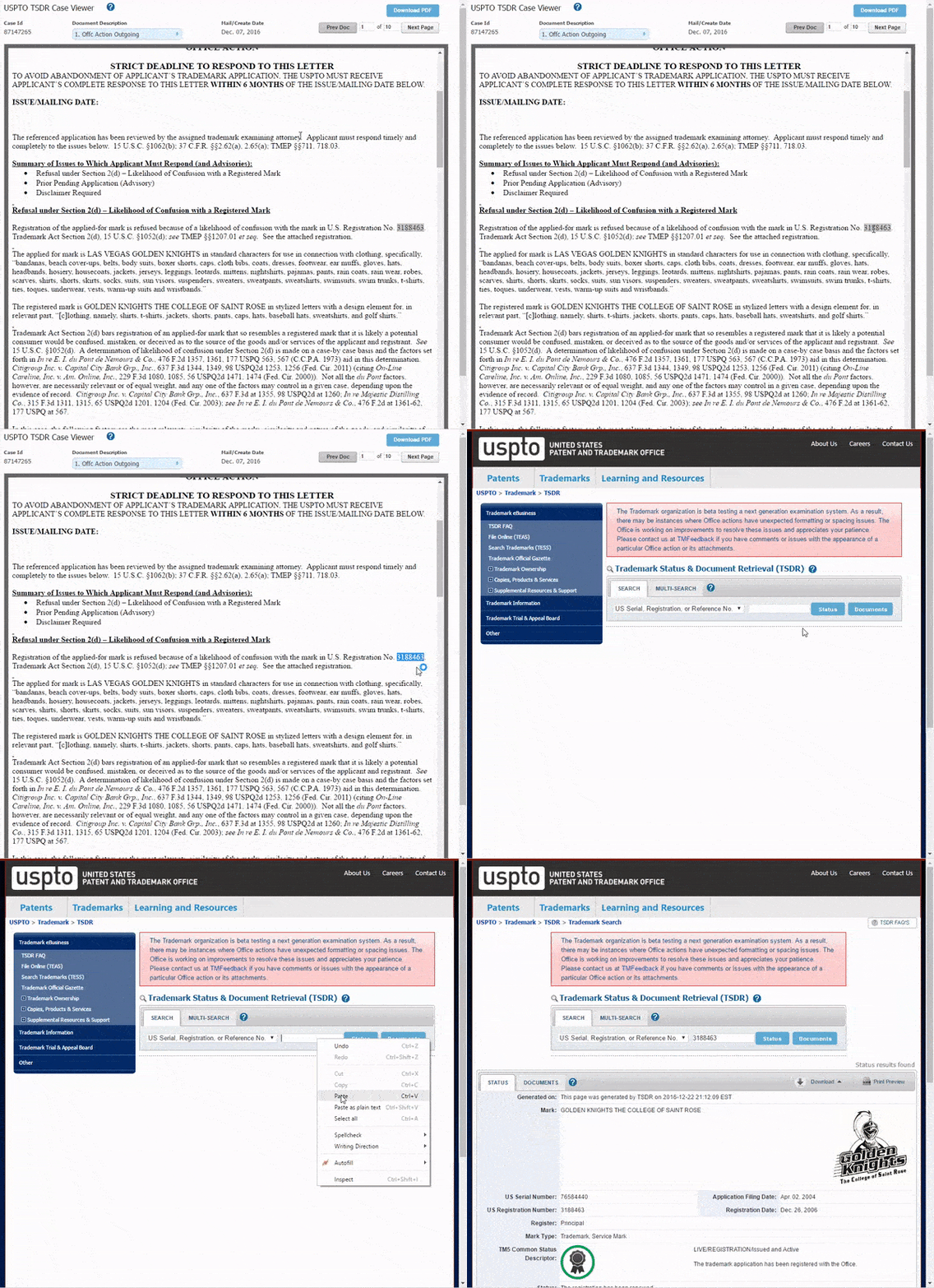
In our example, the “LAS VEGAS GOLDEN KNIGHTS” trademark application was refused based on a likelihood of confusion with the “GOLDEN KNIGHTS” College of Saint Rose logo registration, as seen at the end of the animation above.
Step 2: Analyze the basic details of the registered trademark

Elements of the main registration page:
- Literal portion of the design mark
- The date the application was filed, or its “priority” date
Pay particular attention to the literal portion of the mark (#1), which will display all of the literal words within the trademark.
The Examining Attorney will usually give more weight to those literal words than to a design.
Step 3: Analyze the goods and services, first use dates, and owner information
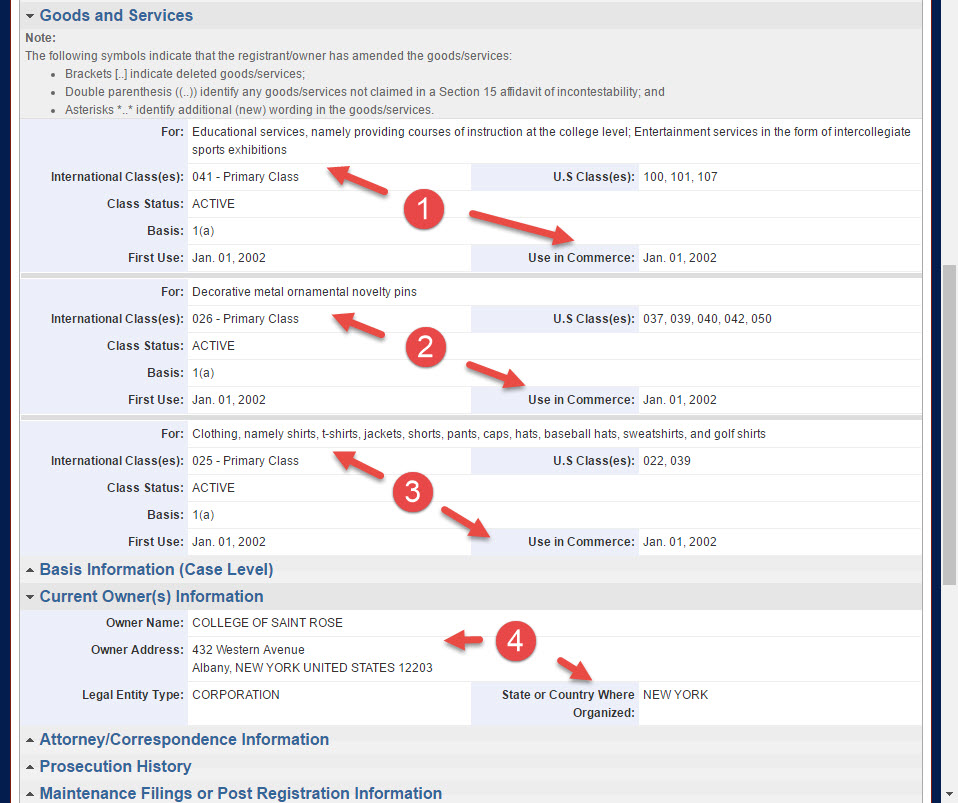
Next, look at the goods and services (#1-3, above) of the identified registration, along with the alleged “First Use in Commerce date.”
Note: These dates are not binding and were self-reported by the registrant. Do not rely on these as conclusive evidence of the actual first date of use and always do additional research.
Now that you’ve reviewed the registered trademark, consider your own first-use dates and listed goods and services.
For the first-use dates, can you claim a date earlier than what they claimed?
If so, you may be able to cancel their trademark (if it hasn’t been registered for more than five years). Keep in mind that it is always possible that they have earlier (or later) use than what they listed on the registration.
You always have to do additional research on first-use dates to confirm. If you act before having all of the information you could open yourself up to legal problems in the future.
Consider the goods and services in the conflicting registration.
Do you think a consumer would believe that your goods/services would also be sold by sellers of the Registrant’s goods and services? For example, consumers would expect the owner of a hotel to also offer bar or restaurant services because many hotels, in fact, do offer both.
Review the owner information for the conflicting trademark.
What entity is listed as the owner (#4) of the trademark? This information will help you determine whether the trademark is still in use by that owner (as opposed to someone else unrelated to that owner.)
Now that you have a better understanding of why you’ve received a likelihood of confusion refusal, let’s see how you can respond.
How to respond to a likelihood of confusion office action
Trademark office action responses come in many different forms, but effective ones use legal arguments, research, and examples to prove the legal arguments.
For example, let’s say the Examining Attorney denied your trademark for “IN THE WAY” for fast-food restaurant services because of a pre-existing registered trademark for “ON MY WAY”, also for restaurant services.
An effective argument (if supported by proper evidence) may be that “IN THE WAY” has a different commercial impression than “ON MY WAY”.
However, making such a cursory statement on its own would not be enough—you must provide proof that the relevant consumer would view the phrases as distinct.
As a trademark attorney, I might look for cases where similar marks have co-existed in the marketplace or the federal register.
To that end, I would provide citations to previous Trademark Trial and Appeal Board (TTAB) and Federal Circuit cases with similar fact patterns to show why “IN THE WAY” should be registered. If I have the case law to support my position, this argument may be effective in changing the Examining Attorney’s mind.
What else would help?
Evidence that the consumers are sophisticated helps to minimize confusion. For example, if the analysis is between an MRI machine and a surgical implant with a similar name, one could argue the purchasers of these goods are highly sophisticated and unlikely to confuse the two companies.
There are dozens of different considerations to account for in response to a likelihood of confusion refusal. It is highly recommended that you work with an experienced trademark attorney as each argument is specific to each refusal.
Final thoughts
With the right evidence and legal theory, an office action response to a likelihood of confusion refusal can convince the USPTO’s Examining Attorney to withdraw his or her objections and allow your trademark to proceed through the registration process.
However, the best argument is not a one-size-fits-all approach – an effective argument will take into consideration many different factors to come up with a tailored approach for each individual trademark.
Finally, it is always our suggestion to engage legal counsel before responding to a trademark office action.
This is because anything you submit to the USPTO (via a formal response or email) becomes part of the official record of your trademark and will live in the USPTO’s publicly available files forever.
If you submit something in writing to the USPTO that is legally or factually inaccurate it could affect your ability not only to register your trademark but to police your trademark against others in the future.
Our firm is happy to provide a complimentary consultation on your office action to see if we can help. Simply complete our contact form and an attorney will be in touch to discuss your Section 2(d) “Likelihood of Confusion” matter.
DISCLAIMER: Nothing in this blog should be relied on as legal advice. Every trademark situation is unique and you should consult a trademark attorney before filing any response with the USPTO.

Josh Gerben, Esq.
Josh Gerben, Esq. is a nationally recognized trademark attorney and the founder of Gerben IP. Since launching the firm in 2008, he has overseen the registration of over 10,000 trademarks and handled over 1,500 trademark disputes. Josh's practice focuses on building and defending global trademark portfolios for clients. These clients include entrepreneurs, private equity-backed businesses, athletes, celebrities, and public companies. Frequently quoted by major media outlets like CNBC, CNN, The New York Times, and The Wall Street Journal, Josh is widely regarded as a leading authority in trademark law.
Do you need assistance with a trademark matter?
Contact an Attorney Today